Article
Contents · 8 sections
The board pack that approved itself
For six years the board pack of Nirmal Cold Chain Private Limited has carried the same headline: profit after tax, up again. This year's pack proposes more of the same. The company would build one new temperature-controlled warehouse a year for five years, at ₹30 crore each, ₹150 crore in all. Profit after tax would rise from ₹21.0 crore to ₹28.5 crore, a gain of about 36%. The lead bank has indicated that it will lend against 40% of the cost, and the pack shows the loans being serviced comfortably in every year.
Ashok Rane, an independent director who spent his career as a credit officer, reads the pack twice and asks the CFO, Meera Joshi, for something it does not contain: what the company is worth with the programme and what it is worth without it.
Her answer, a week later, fits on one page. Equity is worth about ₹145 crore if the company stops where it is. It is worth about ₹109 crore if it builds all five warehouses. Every year's accounts would show more profit. The shareholders would own less.
Nothing in this is a trick of accounting. The warehouses are real, they fill with customers' pallets, and they earn storage and handling charges. They simply do not make enough of it for the capital they absorb. This article is about that gap and about the one comparison that exposes it early.
Nirmal Cold Chain, its people and every figure in this article are invented for illustration. None of it refers to a real company or person.
What a profit statement charges for
A profit and loss account deducts the cost of raw material, wages, depreciation, tax and interest. Interest is the price of borrowed money, so lenders are paid before profit is struck.
The price of the owners' money is not deducted anywhere. Equity capital also has a cost: it is the return the owners could expect by putting the same money into other investments of similar risk. Nirmal's owners, we shall assume, need about 15% a year. The accounts never show that 15% as an expense, so a company can report a handsome profit while earning less than its owners require.
Take one of the proposed warehouses. It costs ₹30 crore, of which ₹12 crore is borrowed at 10% and ₹18 crore comes from the company's own cash. Once it is full, it is expected to earn ₹2.4 crore of operating profit after tax, which is 8% on the cost. After paying the bank's interest, net of the tax it saves, it leaves ₹1.5 crore of extra profit after tax. The bank is paid, profit rises, and the pack records the project as accretive.
But ₹18 crore of the owners' money, at the 15% they could expect elsewhere, should have earned ₹2.7 crore. The warehouse returns ₹1.5 crore. Profit went up and the owners lost.
Profit after tax is what is left once the lenders are paid. Value is what is left once the owners are paid as well.
Giving every rupee of capital a price
Four ideas carry the argument. Each is defined here once.
Return on invested capital (ROIC) is operating profit after tax (NOPAT: what the business earns before interest, after tax on that operating profit) divided by the capital employed, whether it came from lenders or owners. It asks how hard the money works.
The cost of capital (WACC, the weighted average cost of capital) blends the two prices: the after-tax cost of borrowing and the owners' required return, weighted by how much of each the business uses. For Nirmal we assume a cost of equity of 15%, a cost of borrowing of 10% before tax and a tax rate of 25%, with 40% of capital borrowed. That gives 0.4 × 7.5% + 0.6 × 15% = 12.0%. These are assumptions for illustration, not market observations.
Economic profit is operating profit after tax less a charge for all the capital used: the spread between ROIC and WACC, multiplied by the capital. A business earning 13.5% on ₹200 crore, against a 12% cost of capital, makes economic profit of ₹3.0 crore a year (27.0 less 24.0). It is positive, so the business is creating value over and above the capital put in.
The value-driver relation ties these together. In Nirmal's case it says that growth helps only when each new rupee of capital earns more than it costs, and hurts when it earns less. (In symbols: value = next year's NOPAT × (1 − g ÷ RONIC) ÷ (WACC − g), where g is the growth rate and RONIC the return on new invested capital. When RONIC equals WACC the growth term cancels.)
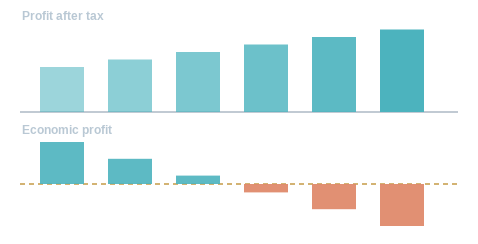
Figure 1 applies this to Nirmal's plan.
Figure 1 · Illustration
Profit climbs for six years. Economic profit turns negative in the fourth.
View as a table
| Year | Profit after tax (₹ crore) | Economic profit (₹ crore) |
|---|---|---|
| Year 1 | 21.0 | 3.0 |
| Year 2 | 22.5 | 1.8 |
| Year 3 | 24.0 | 0.6 |
| Year 4 | 25.5 | −0.6 |
| Year 5 | 27.0 | −1.8 |
| Year 6 | 28.5 | −3.0 |
Economic profit is already shrinking in year 2, while profit after tax is still climbing. It turns negative in the fourth year and keeps falling to minus ₹3.0 crore, because each warehouse absorbs ₹30 crore and earns four percentage points less than that capital costs: ₹1.2 crore a year, added once for every warehouse.
Seen from the owners' side, return on equity falls from 17.5% in year 1 to 14.7% in year 4 and 13.6% in year 6, below the 15% they require. Charging 15% on their ₹120 crore in year 1 leaves ₹3.0 crore of profit after tax, the same figure as economic profit. That agreement holds here because borrowing and equity are added in a steady 40:60 proportion.
The vintage test
If the plan is this poor, why does the company's own ROIC not give it away? In year 6, Nirmal's ROIC on its whole ₹350 crore of capital is 11.1%. That is a little under 12%, not alarming, and a director could be forgiven for calling it close enough.
The average is the problem. It blends two very different groups of capital: the existing business, which earns 13.5% on ₹200 crore, much of it in warehouses built years ago at lower cost and now substantially depreciated, and the new warehouses, which earn 8.0% on ₹150 crore. Figure 2 separates them.
Figure 2 · Illustration
The average hides the vintage
View as a table
| Capital | Return on capital | Against 12% cost |
|---|---|---|
| Existing business | 13.5% | +1.5 points |
| Each new warehouse | 8.0% | −4.0 points |
| Whole company, year 6 | 11.1% | −0.9 points |
The test that works is to split capital by vintage and ask what the next tranche earns, not what the company earns on average. The average records past decisions; the vintage is the decision on the table.
This matters more than it appears because book capital drifts in a flattering direction. Old assets are carried at depreciated cost, so the older the base, the higher the average ROIC looks on that base. New assets arrive at today's construction costs. Each year the programme dilutes the average only slightly, which is why a company can walk a long way down before the average admits it.
Two cautions about the 8%. It is a mature yield, after upkeep and depreciation; a new warehouse earns less while it fills, so ask whether the pack shows the first full year or the mature year. And a flat 8% forever is a modelling choice. If each warehouse's profit instead grew 3% a year in nominal terms with no further capital, the loss per warehouse would shrink from ₹10.0 crore to about ₹3.3 crore and the break-even starting yield would fall from 12% to 9%. An 8% start would still fall short.
What the programme does to value
Value follows from the cash the business will release to its lenders and owners, discounted at the cost of capital. Each year Nirmal's free cash flow to the firm, the cash left for lenders and owners together, is its operating profit after tax less what it invests. A warehouse bought for ₹30 crore that produces ₹2.4 crore a year indefinitely is worth ₹2.4 crore ÷ 12% = ₹20 crore on the day it is built. Spending ₹30 crore to own something worth ₹20 crore loses ₹10 crore, whatever the profit statement says. Each rupee spent is worth ₹0.67.
Five of these, discounted back to today, cost the shareholders ₹36 crore.
Figure 3 · Illustration
Equity value falls from ₹145 crore to ₹109 crore
View as a table
| Step | ₹ crore |
|---|---|
| Enterprise value, no programme | 225 |
| Value effect of the programme | −36 |
| Enterprise value, with programme | 189 |
| Borrowings today | −80 |
| Equity value, with programme | 109 |
| Equity value, no programme (225 − 80) | 145 |
Without the programme the existing business, at ₹27 crore of operating profit after tax, is worth ₹27 crore ÷ 12% = ₹225 crore, which is 1.1 times its ₹200 crore of capital. It is held flat on purpose, with upkeep spending equal to depreciation, so that the effect of the programme stands alone. That is a convenience, not a market view: ₹225 crore is 8.3 times operating profit, and a real warehouse operator may well be valued differently. How growth and risk move a multiple is the subject of the article in this series on businesses with the same EBITDA and different values.
With the programme the enterprise value, meaning the value of the operations as a whole, before deducting what is owed to lenders, is about ₹189 crore. That is less than the ₹200 crore of capital in the business before the first warehouse is built. Deducting today's borrowings of ₹80 crore gives equity of ₹145 crore without and ₹109 crore with the programme, a fall of a quarter. A cross-check by the other route agrees: economic profit discounted to today, added to the ₹200 crore of capital, gives the same ₹189 crore.
How firm is the conclusion? Table 1 changes the two assumptions that matter most, with everything else held where it is.
| Profit yield on new capital | Cost of capital 10% | Cost of capital 12% | Cost of capital 14% |
|---|---|---|---|
| 6% | −45 | −54 | −59 |
| 8% | −23 | −36 | −44 |
| 10% | 0 | −18 | −29 |
| 12% | +23 | 0 | −15 |
| 14% | +45 | +18 | 0 |
| 16% | +68 | +36 | +15 |
Table 1. Change in enterprise value from the five-year programme, ₹ crore, illustrative. Brick cells destroy value, teal cells add it, and the outlined diagonal is where yield equals cost of capital.
The diagonal of zeros is the point. The yield has to equal the cost of capital to break even, and the 8% warehouse only clears if the cost of capital is as low as 8%. That is barely above the 7.5% after-tax cost of the bank's money alone. With 40% borrowed, a cost of capital of 8% means owners asking only about 8.3%, little more than the bank. The plan works only if owners accept almost no premium for taking the risk.
Why the plan still looks sensible
None of this makes the pack's authors careless. Each feature that makes the plan comfortable is real.
The bank is comfortable because a lender asks whether the operations can service the debt, and these can. Even in year 6, operating profit before tax of ₹52 crore covers the ₹14 crore of interest nearly four times. A loan can be safe while the project is a poor use of the owners' capital. The two questions have different answers.
Profit after tax is comfortable because it rises every year. A promoter who has been told that companies like his sell at some multiple of earnings will see his value rise with each warehouse, but only if the multiple stays fixed. A buyer who asks what the warehouses earn will not pay the old multiple for the new profit.
Accounting rarely forces the point. Impairment rules compare an asset's carrying amount with its recoverable amount, the higher of its fair value less costs of disposal and its value in use. Value in use is the present value of expected cash flows at a pre-tax rate. Ind AS 36 sets this out; a private company applies Ind AS only above net-worth thresholds in the Companies (Indian Accounting Standards) Rules, 2015, or if it opts in, and otherwise follows the older Accounting Standards, which have an equivalent test. Take one warehouse: ₹2.4 crore after tax is ₹3.2 crore before tax at a 25% rate, and a pre-tax rate in the region of 12% ÷ 0.75 = 16% gives ₹3.2 crore ÷ 16% = ₹20 crore, against a cost of ₹30 crore. On value in use alone, a shortfall of this kind points towards impairment.
Two things can keep the books quiet. A well-located warehouse may be worth more to a buyer than its own cash flows suggest, which would lift the recoverable amount. And the test is applied to a cash-generating unit, the smallest group of assets whose cash inflows are largely independent of other assets, where older, better-earning warehouses can supply headroom for years. This is an illustration of the mechanism, not an impairment calculation.
Growth is not the culprit
It would be a misreading to conclude that Nirmal should stop growing. Suppose a cold-chain warehouse in a better location, or with a long anchor-tenant contract, earned 16% instead of 8%. The same ₹30 crore would be worth ₹40 crore on completion, and five of them would add about ₹36 crore, the exact mirror of the loss. Same spending and the same profit growth give the opposite sign.
So the question for management is how to raise the return on the next rupee, and the options are practical ones: choose sites for utilisation rather than land price; sign anchor customers before the foundation is poured; check whether any government capital subsidy for cold-chain capacity applies, and on what conditions; lease space instead of building it where the rent is cheaper than the return the capital needs; stage the construction so that each ramp-up is proven before the next commitment; or, if none of that gets the yield above 12%, return surplus cash or repay the 10% borrowings. Repaying debt earns a certain 7.5% after tax with no construction risk, a standard that an 8% warehouse with ramp-up risk does not beat by much.
The calculator below applies the same arithmetic to any programme. It starts with the Nirmal figures. Change the yield and the cost of capital and see where the sign flips.
Calculator
Does the next programme earn its capital?
The defaults are the Nirmal Cold Chain figures from this article. Replace them with your own business and plan. Everything is in ₹ crore, with year-end cash flows and a constant cost of capital. It is an educational model, not a valuation.
Result
- Value effect of the programme
- −₹36.0 crore
- Value of each ₹1 invested
- ₹0.67
- Equity value without
- ₹145.0 crore
- Equity value with
- ₹109.0 crore
- Break-even profit yield
- 12.0%
- Enterprise value without / with
- ₹225.0 / ₹189.0 crore
A yield below the break-even level means each rupee spent is worth less than a rupee, however much profit after tax grows.
Year by year
| Year | Opening capital | NOPAT | Profit after tax | ROIC | Return on equity | Economic profit |
|---|---|---|---|---|---|---|
| 1 | 200.0 | 27.0 | 21.0 | 13.5% | 17.5% | 3.0 |
| 2 | 230.0 | 29.4 | 22.5 | 12.8% | 16.3% | 1.8 |
| 3 | 260.0 | 31.8 | 24.0 | 12.2% | 15.4% | 0.6 |
| 4 | 290.0 | 34.2 | 25.5 | 11.8% | 14.7% | −0.6 |
| 5 | 320.0 | 36.6 | 27.0 | 11.4% | 14.1% | −1.8 |
| 6 | 350.0 | 39.0 | 28.5 | 11.1% | 13.6% | −3.0 |
₹ crore except percentages. On narrow screens the opening capital and NOPAT columns are hidden; they are in the calculator on wider screens. Economic profit = NOPAT less cost of capital x opening capital. Return on equity uses opening equity; equity is assumed to be the capital not funded by debt.
What to ask before the next approval
A board does not need a valuer in the room for the first step. It needs the pack to show three things beside the profit forecast: what the next tranche of capital earns once it is mature and after depreciation; a charge for the owners' capital (the capital times the return they require) set against profit after tax; and the year in which economic profit turns negative, if it does. For Nirmal that year is the fourth, and a pack that shows it early changes the debate.
The same arithmetic applies when growth is bought instead of built, with a purchase price and an integration bill added; the article in this series on acquisitions that destroy value takes that up.
What no pack shows is the comparison that decides the matter. The ₹150 crore could repay 10% borrowings, be paid out as dividend, buy back shares or stay as cash, and each of those has a return too. Whether an 8% warehouse beats them depends on how much risk the owners think the warehouse carries, and on that the promoter and the independent director may still disagree.
Talking it through
If a valuation question is in front of you, a conversation about purpose, scope and the information needed is usually the right first step.
Technical notes
- All amounts are in ₹ crore. Cost of equity 15%, pre-tax cost of borrowing 10%, tax 25% and 40% borrowed capital are assumed for illustration; they give a cost of capital of 12.0%. They are not market observations. The 25% tax rate is a round figure: the concessional regime for domestic companies in section 200 of the Income-tax Act, 2025 charges 22% before surcharge and cess.
- The model uses year-end cash flows, a constant cost of capital, an existing business held flat (upkeep spending equal to depreciation) and a new warehouse yield of 8% on cost, flat after maturity. Investment is made at the end of each of years 1 to 5 and earns from the following year. Each warehouse is funded 40% by borrowing and 60% by owners' capital.
- Rounding: the text rounds to the nearest ₹ crore (₹225 crore less ₹36 crore gives ₹189 crore; less ₹80 crore of borrowings gives ₹109 crore). The unrounded values are ₹225.0, −₹36.0, ₹189.0 and ₹109.0 crore to one decimal place.
- The model does not include inflation in the existing business, the ramp-up period of a new warehouse, working capital for the new capacity, or any scenario in which the programme changes the risk of the business. Allowing the profit of each warehouse to grow by 3% a year, as a sensitivity, reduces the loss to about −₹12 crore but does not change its sign.
- Weights in the cost of capital are book-capital proportions (40% borrowed), held constant; a market-value weighting would shift as the programme changes enterprise value. Growth in the 3% sensitivity means profit that grows with no further capital, in nominal terms.
- The impairment example is an illustration of how a pre-tax value in use compares with cost. It is not an impairment calculation, and the pre-tax rate of 16% is an approximation made for the illustration.
- This is an educational model, not a valuation report.
References
Checked on 5 November 2026. Cited in general terms only.
- Income-tax Act, 2025: section 200 (tax on income of certain domestic companies; optional 22% rate, which continues the earlier section 115BAA of the Income-tax Act, 1961). Text read from a reproduction of the section; the official page could not be retrieved on the date checked. www.incometaxindia.gov.in
- Indian Accounting Standard (Ind AS) 36, Impairment of Assets: paragraphs 6 (value in use; cash-generating unit), 9 (assessment at the end of each reporting period), 12(g) (internal indication of worse-than-expected performance) and 55 (pre-tax discount rate). Text read from a published copy of the standard; check the version notified for your reporting period.
- Companies (Indian Accounting Standards) Rules, 2015, rule 4: applicability of Ind AS to unlisted companies by net-worth threshold, or by voluntary adoption. Cited in general terms; the threshold figures are not quoted because the primary text could not be retrieved on the date checked.
- Koller, T., Goedhart, M. and Wessels, D., Valuation: Measuring and Managing the Value of Companies (Wiley; the value-driver formula and the distinction between ROIC and the return on new invested capital). Edition and page numbers not checked.
About this article
This article and its illustrations are for general education. They are not a valuation, a valuation report under any law, or advice on any transaction, tax or regulatory matter.
A valuation for a real decision depends on the facts, the purpose, the date, the applicable law and standards, and the information available. Please seek professional advice before relying on any figure.
Nirmal Cold Chain Private Limited, Meera Joshi, Ashok Rane and every figure about them are invented for this article. They do not describe any real company, person or transaction.