Article
Contents · 8 sections
Fourteen months of cash, ₹198 crore of value
On the model used in this article, Pravah Cloud has enough cash to last about fourteen months and is worth about ₹198 crore. Both statements are true at once, and the gap between them is what this article is about.
Pravah sells subscription software to pharmaceutical distributors. Last year it earned revenue of ₹120 crore and made an operating loss of ₹36 crore. A lender reading only the profit and loss account would see a company that burns cash, needs money soon and has no earnings for anyone to put a multiple on. A valuer has to look inside the loss. It may be a down payment on revenue that keeps paying for years. It may be simply what the business costs to run.
The title borrows a phrase usually kept for famous start-ups. Pravah is far smaller, and the reasoning is the same at any size. It also applies beyond start-ups: a mid-sized unlisted company spending ahead of its earnings, on a new product line, a plant or a distribution network, faces the same questions from a bank or an incoming investor.
A loss is not good or bad in itself. What matters is what the money bought, how long it takes to pay back, and whether the company is still standing when it does.
Pravah Cloud and Tazaa Basket, introduced below, are made up for this article, and so is every number attached to them.
A purchase and a leak
Start with the question that costs nothing to ask: what would the loss be if the company stopped trying to grow tomorrow?
Of Pravah's ₹120 crore of revenue, ₹36 crore goes on serving customers, ₹30 crore on keeping them renewing, ₹24 crore on product development and ₹12 crore on administration. That leaves ₹18 crore. The loss exists because Pravah also spent ₹54 crore on winning new customers. Take that spending away and, for a while, Pravah is a business with a 15% margin. Its loss is a decision.
The decision can be judged. Each rupee of new annual subscription cost ₹1.35 to win and leaves ₹0.45 a year after the cost of service and retention. Without any customers leaving, that takes three years to pay back. Customers do leave, so allow for it: if 10% of that revenue goes every year and money is worth 13%, a rupee of new subscription is worth about ₹1.96 today. Spending ₹1.35 to buy ₹1.96 of value makes sense. Across the roughly ₹40 crore of new subscriptions that last year's spending bought, the gain is about ₹24 crore. The bet stops paying only if customers leave faster than about 20% a year, and a buyer can test that against records of how each batch of customers, a cohort, has actually renewed.
Now take a second company, Tazaa Basket, a quick grocery delivery start-up with the same revenue and the same loss. An average basket is ₹400, of which the company keeps ₹80 as product margin. Picking, packing, the rider and the dark store cost ₹96 an order, and promotions another ₹18. Every order loses ₹34. On 30 lakh orders that is ₹10.2 crore. Head office and technology cost a further ₹25.8 crore, which brings the total to the same ₹36 crore.
Stop growing and Tazaa still loses ₹36 crore. Keep growing and each extra lakh orders adds ₹0.34 crore to the loss.
Pravah Cloud subscription software
Tazaa Basket quick grocery delivery
₹ crore, last financial year, drawn on one scale. Pravah's growth-spend bar is longer than its reported loss because the existing customer base earns +18.0 before that spending. Both companies are fictional and every figure is invented for this article.
The two losses are the same only at the bottom line. Pravah can switch its loss off by stopping the growth spend. Tazaa's grows with every order.
What would have to be true for a leak to stop
Tazaa may still work, but the case for it has to rest on different evidence.
Scale spreads fixed costs across more sales. It does not change the sign of a cost incurred on every sale. For Tazaa, break-even means the cost of fulfilling and discounting an order must fall far enough that the ₹80 of product margin covers it and also carries the head office. The table shows how far, if head-office cost is assumed to rise as the company grows.
| Orders a year, with assumed head-office cost | Break-even ceiling per order (₹) | Fall needed from today's ₹114 |
|---|---|---|
| 30 lakh (today), ₹25.8 crore | −6 | Not reachable |
| 1 crore, ₹45.0 crore | 35 | 69% |
| 3 crore, ₹60.0 crore | 60 | 47% |
The ceiling is the most fulfilment and promotion cost an order can bear: the ₹80 of product margin less the head-office cost spread over each order (₹86, ₹45 and ₹20 at the three volumes).
At today's volume even free delivery would not cover the head office. At three crore orders, fulfilment and discounts would have to fall from ₹114 to ₹60 an order. The table leaves out levers a real company would pull: advertising and handling fees earned per order, a bigger basket, a higher margin. Each is an assumption someone is making, and each can be checked in the company's own data. Older, denser stores should already show a lower cost per order than new ones. If the oldest stores still lose ₹30 an order, the table is optimistic.
Scale is a divisor, and a divisor helps only the cost it divides.
Pricing the years after the losses
Pravah can be valued from a ten-year cash forecast. Every input is assumed for illustration and is listed in the technical notes at the end; none is observed market data. In outline: revenue growth starts at 30% and fades to 5% by year ten, the operating margin climbs from −30% to 22% over eight years, and cash flows are discounted at 13%.
Terms used in this section
- Free cash flow (FCFF)
- Cash the operations generate after tax and after the money put back into the business to support growth. Negative while a company is burning cash.
- Discount rate (WACC)
- The yearly return that lenders and investors together require. Future cash is divided by it, year by year, to give today's value. It is assumed to be 13% here.
- Enterprise value
- What the operations are worth before debt, cash and any future funding. It is not the value of a shareholding.
- Value beyond year ten (terminal value)
- The value, at the end of the forecast, of every year after it, calculated from a steady growth rate.
- Cohort
- Customers who joined in the same period, followed to see how many renew.
- Usable past losses
- Earlier tax losses that can be set against later profit. The model assumes ₹90 crore is available; whether it is depends on tax law and conditions that were not checked.
The first year needs a word of reconciliation. Growth of 30% is ₹36 crore of extra revenue. Replacing the ₹12 crore lost to customers who leave, that takes ₹48 crore of new subscriptions, which at last year's cost of winning customers means about ₹65 crore of growth spending against ₹54 crore last year. The model does not trace that spending line by line; its margin path is meant to allow for it.
Free cash flow is negative for five years. It first turns positive in year six, and the company has recovered its cumulative burn only in year nine.
- Annual free cash flow, negative
- Annual free cash flow, positive
- Cumulative, not discounted
Pravah Cloud base case, ₹ crore, free cash flow to the firm (FCFF) after tax and reinvestment. Assumed for illustration; see the technical notes.
View as a table
| Year | Revenue | FCFF | Cumulative FCFF |
|---|---|---|---|
| 1 | 156.0 | −51.1 | −51.1 |
| 2 | 198.5 | −50.7 | −101.8 |
| 3 | 247.0 | −45.3 | −147.1 |
| 4 | 300.5 | −33.4 | −180.5 |
| 5 | 357.3 | −13.8 | −194.3 |
| 6 | 414.8 | 14.3 | −180.0 |
| 7 | 470.1 | 50.7 | −129.3 |
| 8 | 519.7 | 85.7 | −43.6 |
| 9 | 560.2 | 76.3 | 32.7 |
| 10 | 588.2 | 85.8 | 118.5 |
Discounted, the first five years are worth −₹144.3 crore and years six to ten are worth +₹111.4 crore. The value beyond year ten is worth +₹230.9 crore today. Together that is an enterprise value of about ₹198.0 crore, or 1.6 times last year's revenue.
Present value at 13%, ₹ crore. Figures are rounded to one decimal, so displayed parts can differ from displayed totals by ₹0.1 crore. The 60% survival probability and the ₹30 crore value on failure are assumed for illustration, not observed.
View as a table
| Component | ₹ crore |
|---|---|
| Present value, years 1–5 | −144.3 |
| Present value, years 6–10 | 111.4 |
| Present value of value beyond year 10 | 230.9 |
| Enterprise value if it survives | 198.0 |
| Weighting for failure | −67.2 |
| Survival-weighted enterprise value | 130.8 |
The last block is larger than the total. The value beyond year ten is 117% of the enterprise value, because the first ten years together contribute less than nothing to the sum. A loss-making company is valued, to a large extent, on the part of the future that any forecast sees least clearly.
Two choices keep that block restrained. Growth after year ten is 5%, an assumed nominal rate well below the discount rate. After year ten, new capital is assumed to earn only the 13% discount rate (the idea behind the article on terminal value). That is why free cash flow in year eleven, ₹62.7 crore, is lower than year ten's ₹85.8 crore: the forecast years imply a return on new capital of about 41%, and the step down to 13% means more of each year's profit has to be reinvested. The model gives no multiple to lift onto another company. It shows what must come true for a given price to be reasonable.
The cash has to arrive before the value does
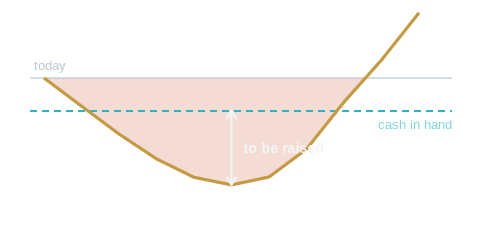
The forecast assumes the burn is financed. The cumulative low is ₹194.3 crore at the end of year five. If Pravah holds ₹60 crore today, ₹134.3 crore must come from someone else.
This is where a discounted cash flow value and a survivable business part ways. The ₹198.0 crore is the value of the operations if the funding arrives. If investors close their wallets in year three, the path to year six does not exist, and the number is of no use to those holding the company at the time.
Who writes the cheque, and on what terms, decides how much of that value stays with today's shareholders. How a funding round divides that value between founders and investors, and why a negotiated price can sit away from a model value, belongs to the article on dilution. For a lender the point is plainer. A company with no earnings cannot pay interest out of earnings, so any debt will be priced from its cash cover, its security and its backers. Loss-making companies are not shut out of public markets: one that fails the main-board profitability test can list through the route in which at least 75% of the net offer goes to qualified institutional buyers (SEBI's FAQ on the issue-of-capital regulations, May 2025).
Survival is a probability, not a premium
The ₹198.0 crore assumes Pravah gets there. Suppose a prudent investor puts the chance of reaching maturity at 60%, and that if the company fails, the customers, code and assets fetch ₹30 crore. Both are assumed for illustration.
Enterprise value, ₹ crore. The 60% and the ₹30 crore are assumed for illustration; the ₹30 crore is what remains after the burn up to failure.
The survival-weighted enterprise value is then 0.6 × ₹198.0 crore + 0.4 × ₹30 crore, or ₹130.8 crore. The ₹30 crore is what the business would fetch after the burn up to the failure has been spent.
One shortcut is to leave the cash flows alone and use a much higher discount rate for start-ups. It does produce a lower number, but it hides what it is doing. To land on ₹130.8 crore from the same cash flows, the rate has to rise only from 13% to about 14.8%. A rise of under two points sounds like a modest premium and conceals a 34% cut. An analyst who prices failure into the rate and also scales the cash flows by a survival probability counts the same risk twice.
There is a reason to keep survival in the cash flows. Failure happens at a particular time, with particular proceeds, and it wipes out every later cash flow. A discount rate spreads that event evenly across all years, including those that would never have arrived.
Survival is not the default. In the United States, roughly half of new employer establishments are still operating five years later (45% to 52% across cohorts from 1994 to 2021, Bureau of Labor Statistics). That covers every kind of business and says little about a funded Indian company. The 60% here is a judgement to defend.
What moves the answer
The first table shows the enterprise value if the company survives, for combinations of discount rate and mature margin. The second shows the survival-weighted value for combinations of years taken to reach the mature margin and chance of survival.
| Surviving enterprise value, ₹ crore | Mature margin 16% | Mature margin 22% | Mature margin 28% |
|---|---|---|---|
| Discount rate 11% | 150.9 | 305.1 | 458.5 |
| Discount rate 13% | 76.8 | 198.0 | 318.3 |
| Discount rate 15% | 27.7 | 125.6 | 222.6 |
| Survival-weighted value, ₹ crore | Survives 40% | Survives 60% | Survives 80% |
|---|---|---|---|
| Mature margin in 6 years | 128.7 | 178.1 | 227.5 |
| Mature margin in 8 years | 97.2 | 130.8 | 164.4 |
| Mature margin in 10 years | 64.9 | 82.3 | 99.7 |
A six-point cut in the mature margin takes about three-fifths off the base value. Two years' delay in reaching maturity removes 37% of the survival-weighted value, with every other input unchanged. Time matters twice: a late profit is discounted more, and it is more exposed to the funding risk described above. The calculator applies the same model to any set of assumptions, and its defaults reproduce Pravah.
Calculator
What does a loss-making business have to become?
Change the story and watch the value, the cash the company must raise, and the discount rate that would be needed to hide the failure risk. The defaults reproduce Pravah Cloud from the article. Fixed in the background: 5% long-run growth, ₹1 of new capital for every ₹2.50 of extra revenue, 25% tax after an assumed ₹90 crore of usable past losses, and, after year 10, new capital earning exactly the discount rate.
Result
Some inputs need correcting. Results are hidden until they are valid.
- Enterprise value if it survives
- ₹198.0 crore
- Survival-weighted value
- ₹130.8 crore
- First year of positive cash flow
- Year 6
- Deepest cumulative burn
- ₹194.3 crore
- Funding gap after cash in hand
- ₹134.3 crore
- Share of value from beyond year 10
- 117%
- Discount rate that would mimic the failure weighting
- 14.8%
Enterprise value, ₹ crore, as a teaching illustration and not a valuation conclusion. Much of the value sits beyond the forecast, so read the figure as a statement of what must come true.
Cumulative free cash flow by year (₹ crore)
What the accounts cannot say
Ask a loss-making company one thing before anything else: if it stopped buying growth tomorrow, what would the loss become? A positive answer leads to the next question, what each rupee of that spending returned, which the company's own cohort records can settle. A negative answer leads to its cost base and to the table in the third section.
The last link cannot be settled from records. The value above rests on ₹134.3 crore arriving on time from people who have not yet decided to provide it. A founder can improve every number in the model and still have no vote in that decision.
Talking it through
If a valuation question is in front of you, a conversation about purpose, scope and the information needed is usually the right first step.
Technical notes
- All amounts are in ₹ crore unless stated. Figures are rounded to one decimal place, so displayed parts can differ from displayed totals by ₹0.1 crore (the parts −144.3 + 111.4 + 230.9 reconcile to 198.0); percentages are rounded to whole numbers.
- The Pravah Cloud model is an educational illustration, not a valuation report, and its size (about ₹198 crore of enterprise value) is far below the 'billion-dollar' of the title. Every input is assumed for illustration: first-year growth 30% fading evenly to 5% in year 10; operating margin rising evenly from −30% to 22% over eight years; ₹1 of new capital for every ₹2.50 of extra revenue; 25% tax after an assumed ₹90 crore of usable past losses and the losses of the early years; discount rate 13%; year-end cash flows; after year 10, growth of 5% with new capital earning exactly the discount rate (so growth adds no value beyond its cost); 60% chance of survival and ₹30 crore of enterprise value on failure, net of the burn before failure.
- The first-year growth of 30% is ₹36 crore of extra revenue. Replacing ₹12 crore of revenue lost to churn, that needs ₹48 crore of new subscriptions, about ₹65 crore of growth spending at last year's ₹1.35 per rupee, against ₹54 crore last year. The model works from margins and does not model customer acquisition cost explicitly; the margin path is meant to absorb this rise.
- Enterprise value is the value of operations before net debt, surplus cash and any future funding. The model does not convert it into the value of a shareholding, which depends on the terms of past and future funding rounds and on net debt or cash.
- The survival weighting is a two-state simplification. A fuller treatment would model the timing of failure and several outcomes, which is outside this article.
- The discount rate that 'mimics' the failure weighting is the rate at which the surviving cash flows, including the value beyond year 10 recalculated at that rate, have a present value equal to the survival-weighted value.
- Whether past tax losses remain usable depends on the tax law in force and on conditions such as continuity of shareholding. The model assumes the stated amount is usable; that assumption has not been checked against any provision, and the 25% rate is assumed, not a statement of the statutory rate.
- The unit economics for Pravah (₹1.35 of spending for each ₹1 of new annual revenue, ₹0.45 a year of contribution after the cost of service and retention, 10% annual churn, 13% discounting, year-end receipts) ignore product development and administration, which are treated as shared costs. Three-year payback is 1.35 / 0.45, before any churn.
- Tazaa Basket's head-office cost at higher volumes (₹45.0 crore and ₹60.0 crore) is an assumption used to show what would have to be true; it is not a forecast. The what-must-be-true table ignores advertising and fee income per order.
References
Checked on 5 November 2026. Cited in general terms only.
- U.S. Bureau of Labor Statistics, Business Employment Dynamics: establishment survival rates since birth, total private, cohorts of the year ended March 1994 to March 2021 (five-year survival 45.4% to 51.9%). www.bls.gov
- Securities and Exchange Board of India, Frequently Asked Questions on Issue of Capital and Disclosure Requirements (May 2025): the QIB route, with at least 75% of the net offer allotted to qualified institutional buyers. www.sebi.gov.in
- Aswath Damodaran, The Dark Side of Valuation: Valuing Young, Distressed, and Complex Businesses (chapter on young and start-up companies), for the general approach of valuing failure risk explicitly.
About this article
This article and its illustrations are for general education. They are not a valuation, a valuation report under any law, or advice on any transaction, tax or regulatory matter.
A valuation for a real decision depends on the facts, the purpose, the date, the applicable law and standards, and the information available. Please seek professional advice before relying on any figure.
Pravah Cloud and Tazaa Basket are made up for this article, as is every number attached to them; any resemblance to a real business is accidental, and nothing here values one.