Article
Contents · 7 sections
The truck at the weighbridge
On a Monday in March a cement bulker stopped at the weighbridge of Sarthak Precast in Raipur and would not move. Its driver had been told by his own office that nothing was to be unloaded until the money was in hand. The yard supervisor, who had bought from that supplier for eleven years on forty-five days' credit, rang accounts. Accounts had no answer, because the cash was already spoken for.
Sarthak makes concrete slabs, culvert boxes and retaining panels in a yard and plant outside the city and sells them to road and housing contractors. It has 310 people on the payroll and sales of ₹96 crore a year. In a normal year it earns ₹16.0 crore before interest, depreciation and tax (EBITDA). Its contractor customers pay slowly, so about ₹32 crore, roughly four months of sales, sits in receivables, and ₹16 crore of cash credit from the lenders carries it. Beyond that cash credit the company owes ₹30 crore of term loans, ₹5 crore of unsecured loans, ₹12 crore to suppliers and transporters, ₹2.4 crore to the Government, and ₹2.6 crore in unpaid wages. The claims total ₹68.0 crore.
Everyone who now looks at Sarthak, whether a lender, a prospective buyer, a resolution professional, or the promoter's family, will ask what it is worth. This article argues that the question has no single answer on that Monday. It has a different answer for each of the next six months, and for each of the people owed money, and the useful work is to see which of those differences move anybody's recovery.
Thirteen weeks is the first valuation
Before a business can be valued as anything, it has to reach the date on which a buyer, a creditor committee or a tribunal decides. The working tool for that is a 13-week cash view: every receipt and payment of the coming quarter, week by week, each one tied to an invoice, a payroll or a phone call. Thirteen weeks is long enough to cover three monthly wage runs and a full cycle of statutory payments, and short enough that nobody has to guess.
Figure 1 · Illustration with an imagined company
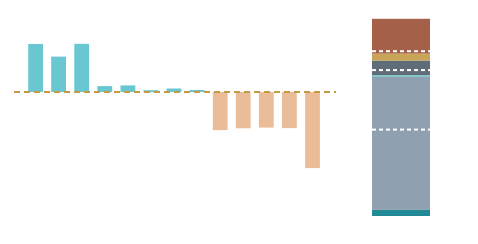
Thirteen weeks of cash for Sarthak Precast
View as a table
| Week | Cash in, ₹ cr | Cash out, ₹ cr | Closing cash, ₹ cr |
|---|---|---|---|
| Week 1 | 1.6 | 0.9 | 2.2 |
| Week 2 | 1.1 | 1.7 | 1.6 |
| Week 3 | 1.5 | 0.9 | 2.2 |
| Week 4 | 1.0 | 2.9 | 0.3 |
| Week 5 | 1.7 | 1.7 | 0.3 |
| Week 6 | 1.2 | 1.4 | 0.1 |
| Week 7 | 1.0 | 0.9 | 0.2 |
| Week 8 | 1.6 | 1.7 | 0.1 |
| Week 9 | 1.1 | 2.9 | −1.7 |
| Week 10 | 1.0 | 0.9 | −1.6 |
| Week 11 | 1.7 | 1.7 | −1.6 |
| Week 12 | 1.4 | 1.4 | −1.6 |
| Week 13 | 1.1 | 2.9 | −3.5 |
Sarthak starts with ₹1.5 crore. It collects ₹17.0 crore over the quarter, well short of the ₹20 crore a quarter it is billing, because customers are slowing payment to a supplier they doubt. It pays ₹8.1 crore for materials in cash as they arrive, ₹6.0 crore of wages in three monthly runs, ₹3.9 crore for power, freight and overheads, ₹3.0 crore to the old suppliers it cannot afford to lose, and ₹1.0 crore for repairs to moulds and safety equipment. Cash holds up to week 8, turns negative in week 9 when the second wage run goes out, and ends the quarter ₹3.5 crore below zero.
That ₹3.5 crore is smaller than something the suppliers have already taken away. With about ₹0.62 crore of materials bought each week, forty-five days of credit was worth ₹4.0 crore of funding that nobody had to arrange. The cash view is therefore the first valuation: any price that anyone will pay for Sarthak is a price for a business that has first found ₹3.5 crore, or has been bought by someone who will.
The view leaves things out, and it is as well to say what. It assumes no interest or loan instalment is paid, which depends on what the lenders decide. It pays only ₹3.0 crore of ₹12 crore owed to suppliers, leaves the ₹2.6 crore of wage arrears unpaid, and sets no tax or GST timing beyond the current month.
What waiting costs
To see what the delay takes, start with what a funded, intact Sarthak would be worth. Enterprise value (EV) is the value of the operating business before deducting what is owed to lenders. With sales growing 4% a year, EBITDA staying at 16.7% of sales, and owners requiring 13% a year on the business as a whole, EV comes to ₹71.9 crore, 4.5 times EBITDA. The 13% and the 4% are assumed for illustration; so is the multiple that results from them, which is an output and not a market observation.
Now take away what distress removes. Contractors who cannot get dispatch commitments place their orders elsewhere. Say the sales run-rate drops from ₹96 crore to ₹80 crore, and that a funded owner wins it back over three years. The lost contribution, after tax and discounted, is ₹7.9 crore. The suppliers' withdrawn credit is ₹4.0 crore. Skilled moulders and the plant engineer start leaving, and replacing them costs ₹1.2 crore. A buyer would rationally price all three.
Figure 2 · Illustration with an imagined company
What the first months of distress take out of the value
View as a table
| Step | ₹ crore |
|---|---|
| Healthy, funded, orders intact | 71.9 |
| Orders lost while unfunded | −7.9 |
| Suppliers withdraw 45 days of credit | −4.0 |
| Skilled staff leave | −1.2 |
| Sold as a going concern now | 58.8 |
| Same sale after nine more months | 49.8 |
The result is ₹58.8 crore, the price of a going concern sold now. (The three deductions, rounded, sum to ₹13.1 crore; the unrounded figure is ₹13.05 crore.) If the sale slips by nine months, the run-rate falls to ₹64 crore, attrition doubles, and the same sale fetches ₹49.8 crore. In this example drift costs about ₹1 crore a month. Distress is a rate of loss, not a state, and every number quoted in it carries a date.
The statute sees the same thing from the other side. Under the IBC resolution regulations, the fair value and the liquidation value of a corporate debtor are both struck as at the insolvency commencement date, which is the date the Tribunal admits the case. The creditors will be weighing plans that arrive months afterwards against numbers frozen at the first day.
Two premises, three prices
The International Valuation Standards (effective 31 January 2025) define liquidation value by a seller who is compelled to sell on a given date, and they allow two versions of it: an orderly one, with the marketing period that is usual for the asset, and a forced one, with a cut-down period. The valuer must say which version has been assumed (IVS 102 Bases of Value, Appendix A60.01 and A60.02). A "forced" sale, they add, describes the situation under which the exchange takes place and is not a basis of value in itself; the price depends on the pressure on the seller (A120.01). For businesses, IVS 200 allows multi-scenario models where cash flows are very uncertain (paragraph 60.13) and warns that the simple shortcut of deducting the value of debt from enterprise value is not appropriate for every company, citing distressed or highly leveraged ones (paragraph 130.05).
Sarthak, on assumptions set out in the notes, therefore has these values today: ₹58.8 crore as a going concern, ₹53.5 crore if its land, plant, stock and receivables are sold in an orderly liquidation, and ₹33.0 crore in a forced sale. The article on going-concern value against liquidation value shows how such asset schedules are built; the article on turnaround businesses takes up the probabilities of recovery. This article stops at the sale.
The gap between the first two is ₹5.3 crore. The cost of a nine-month delay is ₹9.0 crore, which is larger. By then the two premises are within ₹1.3 crore of each other (₹49.8 crore against ₹48.5 crore). In distress the choice of premise matters less than the date at which it is applied.
Five seats, one number
None of these totals is what anybody receives. For the recovery illustration, assume Sarthak has entered liquidation and the liquidator sells either the corporate debtor or its business as a going concern under regulation 32(e) or 32(f) of the Liquidation Process Regulations. That is a going-concern sale in liquidation, not a resolution plan in CIRP. Its realisations enter the liquidation estate and are distributed under section 53. On the Insolvency and Bankruptcy Code as consolidated by the IBBI to 12 August 2021, section 53(1) pays, after insolvency-resolution and liquidation costs, first the dues of workmen (the Companies Act meaning is imported) for the 24 months before liquidation and the debts of secured creditors who have given up their security; then the wages of other employees for 12 months; then unsecured financial debt; then dues of the Central and State Governments for the preceding two years and any shortfall of secured creditors; then everyone else, which is where trade suppliers sit; then preference and equity shareholders. Sarthak's lenders are assumed to have given up their security and so rank with the workmen. The other route, in which a secured creditor enforces its own security, is not modelled.
Figure 3 · Illustration with an imagined company
Claims in order of priority, and where each outcome runs out
View as a table
| Outcome | Value before costs, ₹ cr | Value left for claims, ₹ cr |
|---|---|---|
| Sale as going concern, now | 58.8 | 56.8 |
| Orderly liquidation, now | 53.5 | 50.3 |
| Forced sale | 33.0 | 29.8 |
| Sale, nine months later | 49.8 | 47.8 |
| Orderly liquidation, nine months later | 48.5 | 45.3 |
Read the figure from the bottom. The claims stack to ₹68.0 crore; assumed process costs of ₹2.0 crore for the going-concern liquidation sale and ₹3.2 crore for the asset-sale routes come off the value first. The going-concern liquidation sale leaves ₹56.8 crore, which pays everyone through the Government and leaves ₹0.8 crore of the ₹12.0 crore owed to trade creditors. An orderly asset sale leaves ₹50.3 crore: lenders, workmen and other employees are whole, the unsecured financial creditor gets ₹1.7 crore of ₹5.0 crore, and the Government and the suppliers get nothing. A forced asset sale leaves ₹29.8 crore, inside the lenders' own band; they and the workmen recover 62%.
Three things follow. First, the secured lenders are paid in full in the going-concern liquidation sale and in the orderly asset sale alike, so within this liquidation illustration they have no financial stake in the choice between those two routes. The ₹6.5 crore difference between them, after the assumed process costs, falls entirely on the unsecured financial creditor (₹3.3 crore), the Government (₹2.4 crore) and the suppliers (₹0.8 crore). Second, this waterfall cannot be carried across to a CIRP resolution plan. Financial creditors approve a plan with at least 66% of their voting share under section 30(4), but the plan fixes its own distribution subject to section 30(2) floors and regulation 38 payment priorities. Figure 3 therefore shows liquidation recoveries and plan floors, not what a plan would actually pay. Third, recovery is a staircase. A delay that takes the sale from ₹56.8 crore to ₹47.8 crore costs the lenders under ₹0.4 crore, but drops the unsecured financial creditor from full recovery to nothing.
Calculator
Who is paid, outcome by outcome
The defaults are Sarthak Precast's. Replace them with the value you think each outcome would realise and the claims actually standing against the company. Amounts are in ₹ crore. The calculator pays the classes in the order of section 53(1) of the Insolvency and Bankruptcy Code, as if every secured lender had given up its security to the liquidation estate. It reports who is paid; it does not say which outcome is likely, and it is not a valuation.
Result
| Claimant | Sold as going concern | Orderly liquidation | Forced sale |
|---|---|---|---|
| Workmen's duesclaim ₹2.1 cr | ₹2.1 cr100% | ₹2.1 cr100% | ₹1.3 cr62% |
| Secured lendersclaim ₹46.0 cr | ₹46.0 cr100% | ₹46.0 cr100% | ₹28.5 cr62% |
| Other employeesclaim ₹0.5 cr | ₹0.5 cr100% | ₹0.5 cr100% | ₹0.0 cr0% |
| Unsecured financial creditorsclaim ₹5.0 cr | ₹5.0 cr100% | ₹1.7 cr34% | ₹0.0 cr0% |
| Government duesclaim ₹2.4 cr | ₹2.4 cr100% | ₹0.0 cr0% | ₹0.0 cr0% |
| Operational creditorsclaim ₹12.0 cr | ₹0.8 cr7% | ₹0.0 cr0% | ₹0.0 cr0% |
| Left over for shareholders | ₹0.0 cr | ₹0.0 cr | ₹0.0 cr |
| Value left after process costs | ₹56.8 cr | ₹50.3 cr | ₹29.8 cr |
| Where the money stops | Stops at trade creditorsneeds ₹11.2 cr more | Stops at unsecured financialneeds ₹3.3 cr more | Stops at workmen and lendersneeds ₹18.3 cr more |
Read each column downwards: the money is exhausted at the first class that is only partly paid, and every class below it receives nothing. Percentages are the share of each claim recovered. Total claims entered: ₹68.0 crore.
Try the numbers from your own side of the table. Push the going-concern value down by ₹6.5 crore and watch which classes lose. Or enter ₹40 crore as the security behind the lenders' claim: the explanation added to section 53(1)(b)(ii) by the Insolvency and Bankruptcy Code (Amendment) Act, 2026 treats the other ₹6 crore as an unsecured debt, which pulls it down the order of payment.
What the resolution regulations ask of the valuers
What follows reads the consolidated Insolvency Resolution Process for Corporate Persons Regulations, 2016 as amended up to 30 October 2026, downloaded from the IBBI site on 6 November 2026. It also uses the Code as consolidated to 12 August 2021 and the text of the 2026 Amendment Act, whose commencement was reported by a law-firm article as 26 May 2026 for the relevant sections; the notification itself was not read. Law in this area is moving, and any provision cited below should be checked against the version in force on the day it is used.
In a corporate insolvency resolution process the resolution professional appoints two sets of registered valuers within seven days of appointment and not later than the 47th day from the insolvency commencement date (regulation 27(1), substituted from 25 February 2026). Where the company is a micro, small or medium enterprise one set is appointed unless the committee records reasons for two (proviso inserted from 20 May 2026). Regulation 35 then produces two different numbers.
| Number | How it is struck under regulation 35 |
|---|---|
| Fair value | The registered valuers in each asset class report the fair value of their assets; the coordinating valuer of each set computes the fair value of the company, "along with their underlying synergies". The average of the two closest estimates from the coordinating valuers is the fair value. |
| Liquidation value | Each registered valuer reports a liquidation value. The average of the two closest estimates submitted by valuers in each asset class is taken as the liquidation value of the company. |
If two estimates differ by 25% or more, or the committee proposes it with reasons recorded, a third set may be appointed. Valuers explain their methodology to the committee before computing, the values and reports go to committee members only after resolution plans arrive and on a confidentiality undertaking, and since 9 June 2026 regulation 39(3)(b) requires the committee to record its deliberations on the expected realisable value to creditors against the fair value and the liquidation value, and on the adequacy of market discovery. Fair value is defined as the estimated realisable value if the company or its assets were exchanged on the insolvency commencement date between a willing buyer and a willing seller after proper marketing, without compulsion. That is a different question from the one the liquidation value answers, and the two numbers are meant to be read together.
The liquidation value matters beyond comparison, because it sets a floor. Under section 30(2)(b) as consolidated, a plan must pay operational creditors not less than the higher of the amount they would receive in a liquidation under section 53 and the amount they would receive if the plan's distributable amount were paid out in the section 53 order; dissenting financial creditors get at least their liquidation amount. The 2026 Amendment Act moves the financial-creditor floor into a new clause (ba) and sets it at the lower of those two amounts. For Sarthak the floor is a product of the waterfall. In liquidation the suppliers get nothing; if a plan distributed ₹56.8 crore, the second route gives them ₹0.8 crore, so ₹0.8 crore is the least a compliant plan could offer them.
Section 29A matters to the family. A person, or anyone acting jointly or in concert with them, who submits a plan while holding an account that was classified as a non-performing asset a year or more before the process began, or an account of a company they manage, control or promote, is ineligible unless the overdue amounts and charges are paid first (section 29A(c)). Regulation 38 also directs that amounts payable to operational creditors are paid ahead of financial creditors under a plan, and dissenting financial creditors ahead of those who voted for it. The calculator does not model a plan or either priority; it is confined to the liquidation waterfall described above.
Also not modelled: tax on a sale, interim finance, avoidance of earlier transactions, the treatment of specific dues such as provident fund contributions, and the possibility that a buyer would pay a premium for what a particular buyer can do with the business.
A test to run before anyone quotes you a number
Take your own company, or one you advise, and do three things with a pencil. First, mark the week in which cash first goes below zero using the real payroll and statutory dates, not averages, and set against it the credit your suppliers have withdrawn. Second, list the claims in the order of section 53, and write the running total beside each class: those totals are the cliffs. Third, estimate the lowest and highest value you consider plausible for each premise, subtract the process costs, and see where they land.
If the whole range falls inside one class, the argument about premise changes nobody's recovery, and the only argument worth having is about speed. If the range straddles a boundary, that boundary is where the valuation is actually bought and sold, and the next piece of evidence worth paying for is whatever narrows the estimate on that side of it.
Talking it through
If a valuation question is in front of you, a conversation about purpose, scope and the information needed is usually the right first step.
Technical notes
- All amounts are in ₹ crore. Sarthak Precast, the 13% required return on the business, 4% growth, the 40% contribution margin, the 25% tax rate, the lost-order path (₹16 crore of sales lost now and ₹32 crore after nine more months, returning in equal steps over three years), the 45 days of supplier credit, the ₹1.2 crore and ₹2.4 crore attrition costs, the process costs of ₹2.0 crore for a sale and ₹3.2 crore for a liquidation, and the realisation values below are assumed for illustration. None is an observed market figure, a typical recovery rate or a typical cost.
- Scale check for the invented company: sales ₹96 crore and 310 people (₹0.31 crore of sales per person); normalised EBITDA ₹16.0 crore (16.7% of sales); depreciation ₹5.0 crore; claims ₹68.0 crore, of which financial debt ₹51 crore, 3.2 times normalised EBITDA; receivables about ₹32 crore, roughly 122 days of sales; enterprise value if healthy ₹71.9 crore, 4.5 times EBITDA. At the distressed sales run-rate of ₹80 crore the cost build in the 13-week view implies EBITDA near ₹8.2 crore, and the contribution model ₹8.4 crore, so financial debt is about six times current EBITDA.
- Healthy value: year-1 free cash flow to the business = EBITDA ₹16.64 crore less tax at 25% on EBITDA less depreciation (₹2.86 crore), less maintenance capital spending equal to depreciation (₹5.2 crore), less working capital ₹0.96 crore (25% of the ₹3.84 crore sales increase) and growth capital spending ₹1.15 crore = ₹6.47 crore, divided by (13% − 4%) = ₹71.9 crore. Distress deductions: lost orders = present value at 13% of lost sales × 40% × (1 − 25%) over three years; supplier credit = ₹0.62 crore a week × 45 ÷ 7 = ₹3.99 crore; attrition as stated.
- Realisation values assumed (orderly now; forced; orderly nine months on), ₹ crore: land and sheds 22, 15, 22; plant and moulds 12, 7, 11; inventory 6.5, 4, 5.5; receivables 13, 7, 10; totals 53.5, 33.0, 48.5. Cash on hand is excluded from every outcome because the 13-week view spends it. Book values are land and sheds 30, plant and moulds 40, inventory 12, receivables 32.
- Rounding: 71.9 − 7.9 − 4.0 − 1.2 = 58.8 reconciles to the unrounded 71.87 − 13.05 = 58.82. The 13-week quarter has cash in of 17.0 and cash out of 21.96, giving a closing balance of −3.46, shown as −3.5. Percentages recovered are rounded to whole numbers.
- Not modelled: interest and instalments (assumed unpaid in the 13 weeks), tax on a sale, the route in which a secured creditor enforces its own security outside the liquidation estate, any CIRP resolution-plan distribution (including regulation 38 payment priorities), interim finance, avoidance of earlier transactions, provident fund and other specifically treated dues, a premium for a particular buyer, and the probability of a turnaround. The recovery calculator is a section 53 liquidation waterfall; its going-concern route is a sale by a liquidator under regulation 32(e) or 32(f). This is an educational model, not a valuation report.
References
Checked on 8 November 2026. Cited in general terms only.
- Insolvency and Bankruptcy Board of India (Insolvency Resolution Process for Corporate Persons) Regulations, 2016, as amended up to 30 October 2026 (IBBI consolidated text): regulation 2(1)(hb) and (k) (fair value; liquidation value), regulation 27(1) and its proviso (two sets of registered valuers; one set for a micro, small or medium enterprise), regulation 35 (fair value and liquidation value), regulation 36(2) (clause (ka) omitted from 30 October 2026), regulation 38(1) and regulation 39(3)(b) (from 9 June 2026). Downloaded from the IBBI site on 6 November 2026 and regulation 38 rechecked on 8 November 2026. ibbi.gov.in
- Insolvency and Bankruptcy Board of India (Liquidation Process) Regulations, 2016: regulation 32(e) and (f), permitting a liquidator to sell the corporate debtor or its business as a going concern. Current IBBI legal-framework material checked on 8 November 2026. ibbi.gov.in
- Insolvency and Bankruptcy Code, 2016 as consolidated by the IBBI up to 12 August 2021: sections 5(12), 14, 20(1), 29A(c), 30(2)(b) and 30(4), 53(1) to (3). Insolvency and Bankruptcy Code (Amendment) Act, 2026 (Act of 6 April 2026, IBBI copy): section 18 (amending section 30(2), new clause (ba)) and section 32 (amending section 53). The notification bringing sections into force was not read in primary form; a law-firm report gives 26 May 2026 for sections 8 to 33. ibbi.gov.in
- International Valuation Standards Council, International Valuation Standards (effective 31 January 2025): IVS 102 Bases of Value, Appendix paragraphs A60.01 and A60.02 (liquidation value) and A120.01 to A120.04 (forced sale); IVS 200 Businesses and Business Interests, paragraphs 60.13 (multi-scenario models) and 130.05 (capital structures; distressed companies). Read from a copy hosted by the South African Institute of Chartered Accountants. www.ivsc.org
About this article
This article and its illustrations are for general education. They are not a valuation, a valuation report under any law, or advice on any transaction, tax or regulatory matter.
A valuation for a real decision depends on the facts, the purpose, the date, the applicable law and standards, and the information available. Please seek professional advice before relying on any figure.
Sarthak Precast, its Raipur yard and every rupee shown for it exist only in this article's arithmetic.